
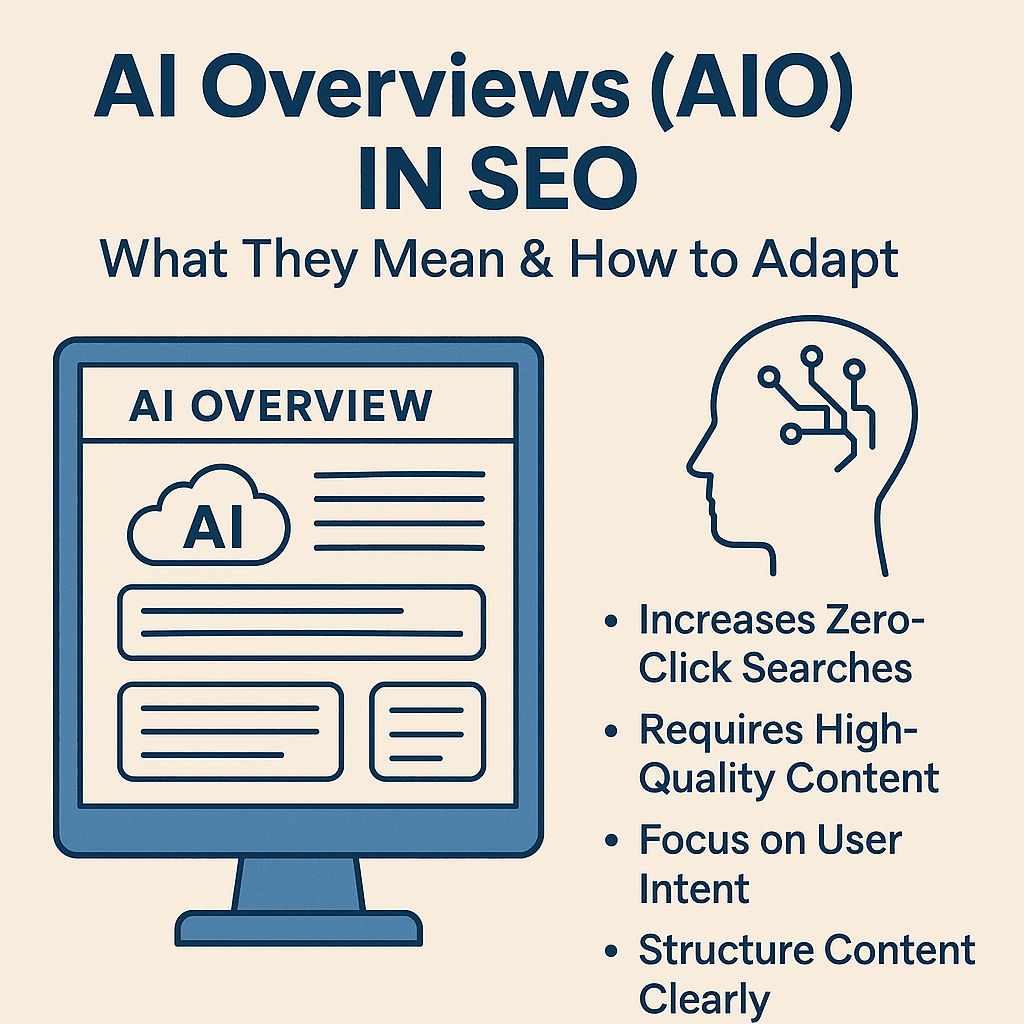
Introduction
As envisioned in 2025, one of SEO’s most transformative shifts is the expansion by Google of the AI Overviews—simply AIO. This single feature has changed the delivery process of results on SERPs through the presentation of relevant content from a number of high-quality sources; it has changed the way users interact with content online.
It is pivotal for any content creator, marketer, or business owner to understand how this technique works and to understand and adapt to it.
What Are AI Overviews?
AI Overviews are brief AI summaries produced on Google’s search results. The aim is to provide an immediate answer without having to visit a website. Instead of arraying all blue links or featured snippets, Google now furnishes users with nearly synthetic responses woven into strong verbatim from across many authoritative sources.
AI Overviews almost mimic the fulfillment of a board-of-directors meeting: Instead of providing one source of information, AI Overviews normally mine multiple sources for any available information, cross-reference it, and then neatly filter that mountain of data for a single, coherent response right on the SERP.
Expansion: The Importance of AI Overviews
1. More Zero-Click Searches
To let queries trigger a definitive piece of zero-click search, AI Overviews only do much to throw more attention toward this trend in which the SERP is used by users not to view further details but to get all required bits of information about the search query. With AIO, this trend is well emphasized. Publishers of content ultimately receive fewer clicks unless the browsers need more of another batch of information that appears in the overview.
2. The Direction Towards Intent-Based Content
Furthermore, AI Overviews will now closely look for content addressing user intent rather than keyword targeting. Therefore, content must answer the question completely, solve the problem, and ensure value in any way. The AI in Google is now smart enough to read between the lines, which might easily render fluff or stuffing less than effective.
3. Addition of More Competition for Visibility
Getting into an AIO summary is practically as good, if not better, than ranking first the traditional method. However, Google may not always credit and make an appearance of the source, which can raise further concerns about brand recon and authority and the click-through rate.
How Does Google Source Content for the AI Overviews?
Google’s approach to generating AI Overviews can be summed up as a combination of:
Content quality and relevance
Authoritativeness (E-E-A-T principles)
Structured data and on-page clarity
Credible sources with consistent publishing histories
It’s absolutely not about keywords in any way. It looks at the rationale behind the entire question, and evaluates how well you explain yourself. Are you direct, succinct, and supported in your explanation? Are you quoting facts or some experts?
Google will love you in that case!
Optimizing for AI Overviews
An AI Overview cannot be gamed, but content strategy can be aligned with better chances of inclusion too.
1. Answer Questions Explicitly
Use question-based headers (H2/H3) and answer the question directly in the paragraph below. For example:
H2: What Are the Benefits of AI Overviews?
Follow this with a concise, 2–4 sentence summary.
2. Have Structured, Scannable Content
Break content with bullet points, tables, small paragraphs, and bolded keywords. They shall render your guide true food for AI (and us human beings).
3. Maximize On The E-E-A-T ‘Heavenly Rewards’
Assure yourself of credibility by sharing your credentials, being interconnected with authoritative sources, and by seeking to spread real-life examples. Somehow or other, Google’s AI loves it when a piece of content was authored by highly experienced or creative minds.
4. Utilize Schema Markup
Structured data enables Google to understand better what a given piece of content is all about. This is why schema falls on various types whenever it comes on page to bolster the context of the page.
5. Update Regularly
AI Overview pulls in various posts. To give your blogs a better chance, upstate them on regular intervals.
Potential Disadvantages of AI Overviews
Though user-friendly, AI Overviews pose certain challenges:
Decreased Traffic: If everything is answered in SERPs, then there is no reason that could prompt clicking onto your site.
Highlighting Unattributed: Not all AI Overviews cite original sources That could lead to bad brand recognition, among other repercussions.
More Competition: The very best content is summarized by AI such that the establishment of some level of content servicing will continue amidst trust.
Having said the above, if your site gets featured by AIO with a clear-link visibility, the ensuing traffic can be high-performing and indeed targeted.
What Can Businesses Do?
1. Deep and Authoritative Content
Thin content will not appeal anymore. Genuine information on this point will go a long way.
2. Underline the Branding
Build a strong brand name for yourself since Google will not always give due credit to your content. Keep consistent visual look, tone, and author bios on your content to reaffirm who you are.
3. Diversify Traffic Sources
It is risky to bank solely on Google traffic. Broaden your existence on places like YouTube, newsletters, social media, and question-answer services such as Perplexity or ChatGPT.
In the End: The Future of Search Is Unveiling
Google AI Overviews have brought a significant change in the direction of user inquiry discovery on the World Wide Web. While it is a little tricky for the content creators and marketers, it comes up as an array of huge opportunities presenting an overwhelming need for higher-quality content that is relevant, clear, and truly valuable.
In a nutshell: Write content that would be worth summarization. Think user, not algorithms, and you should flourish in this post-alignment with AI-powered search.


 English
 Arabic